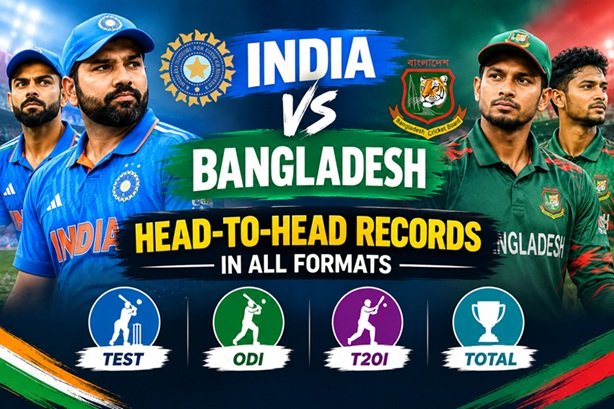

India have held a clear overall advantage against Bangladesh in men’s international cricket, winning 63 of their 75 recorded meetings across Tests, ODIs and T20Is. Bangladesh have won nine matches, while three fixtures ended as draws or no-results. The record is especially one-sided in Tests and T20Is, although Bangladesh have produced several significant ODI wins that give the rivalry more depth than the overall totals alone suggest.
Overall India vs Bangladesh record
The two sides first met in an ODI during the 1988 Asia Cup in Chattogram, where India won by nine wickets. Their first Test followed much later, in Bangladesh in November 2000, and India again won convincingly, by nine wickets. The first T20I meeting came in June 2009, with India winning by 25 runs.
The available head-to-head record lists 15 Tests, 42 ODIs and 18 T20Is between the teams. India’s advantage is present in every format, but the results should be read in their proper context. Test cricket has contained two draws, while ODI cricket has included one no-result. T20I encounters, by contrast, have produced a result every time.
| Format | Matches | India wins | Bangladesh wins | Draw/No result |
| Tests | 15 | 13 | 0 | 2 draws |
| ODIs | 42 | 33 | 8 | 1 no-result |
| T20Is | 18 | 17 | 1 | 0 |
| Total | 75 | 63 | 9 | 3 |
Test record: India unbeaten against Bangladesh
India’s Test record against Bangladesh stood at 13 wins from 15 matches, with the other two games drawn. Bangladesh had not registered a Test victory in this fixture across the listed meetings. That makes the longest format the clearest reflection of India’s historical control in the contest.
The first Test series arrived soon after Bangladesh gained Test status in 2000. India won the opening match of that rivalry by nine wickets. Subsequent series have featured matches in both countries, but Bangladesh’s search for a first Test win against India continued through the latest Test listed, played from 27 September to 1 October 2024. India won that match by seven wickets.
The two drawn Tests remain important when assessing the record. A draw is not equivalent to a defeat in Test cricket, and it can result from weather, time lost, defensive batting or a match that remains evenly placed. India’s 13 wins still indicate sustained superiority, but the two draws show why a raw win count should always be separated from the number of matches played.
Why the Test numbers are so decisive
A 13–0 win split is notable because Tests reward performance across multiple innings and several days. Teams must combine batting depth, bowling control, fitness and tactical flexibility rather than rely on one short phase of play. India’s unbeaten Test run against Bangladesh therefore represents an advantage maintained over a long sequence of series rather than a narrow run of limited-overs results.
For readers studying historical comparisons, the Test record also needs a time boundary. The 15-match total is based on the listed India-Bangladesh meetings through the September-October 2024 Test. It should not be treated as a live fixture count beyond that point without a newer match record.
ODI record: Bangladesh’s strongest format in the rivalry
One-day internationals have produced Bangladesh’s largest share of wins against India. According to MyKhel’s India-Bangladesh ODI head-to-head page, India won 33 of 42 ODIs, Bangladesh won eight and one match had no result. Although India’s advantage remains substantial, Bangladesh’s eight victories make the ODI history more competitive than the Test or T20I records.
Bangladesh’s first win over India came in Dhaka in 2005, following India’s narrow 11-run victory in the opening match of that tour. That breakthrough mattered because it demonstrated that Bangladesh could turn home conditions and close-match pressure into a result against a stronger opponent. The ODI rivalry later included bilateral series wins for Bangladesh as well as close contests in major tournaments.
The recent ODI list illustrates how rapidly a contest can swing. Bangladesh beat India by one wicket on 4 December 2022 and by five runs on 7 December 2022. India responded with a 227-run win in the third ODI on 10 December. In the Asia Cup Super Four match on 15 September 2023, Bangladesh won by six runs, before India won the next listed ODI meetings in October 2023 and February 2025.
Home, away and neutral ODI results
The ODI breakdown gives additional perspective. India recorded four home wins, 18 away wins and 11 neutral-venue wins in the listed 42-match record. Bangladesh recorded six home wins and two neutral-venue wins, with no away wins shown in that breakdown. These figures underline both India’s ability to win in Bangladesh and the importance of venue when interpreting individual results.
Head-to-head figures are a useful starting point rather than a prediction by themselves. Team selection, pitch conditions, match format and recent form can all alter the balance on a given day. Readers comparing statistical context with match-specific information may come across free cricket betting tips, but historical numbers are most useful when they are considered alongside the conditions of the particular fixture.
T20I record: a near-total Indian advantage
The T20I head-to-head record lists 18 matches, with India winning 17 and Bangladesh winning one. Unlike the other formats, there were no draws or no-results in the listed T20I meetings. India’s 17–1 record makes this the most one-sided format between the sides by win percentage.
The first T20I was played on 6 June 2009, and India won by 25 runs. Across the years that followed, India consistently converted their opportunities in the shortest format. T20 cricket can often compress the gap between teams because a short spell, a rapid batting partnership or one tactical decision can decide a match. Yet the overall record shows India repeatedly handling those high-variance moments better in this particular fixture.
The latest T20I listed took place on 28 September 2025, when India won by 41 runs. That result placed the T20I total at 18 meetings. Bangladesh’s single victory remains a reminder that even a heavily tilted head-to-head record does not remove the possibility of an upset, particularly in a format where a small sequence of overs can transform the match.
Tournament meetings add another layer
India’s lead also appears in the listed ICC tournament record. Across 12 matches in the Cricket World Cup, T20 World Cup and Champions Trophy, India won 11 and Bangladesh won one. India were listed with four wins from five Cricket World Cup meetings, five from five T20 World Cup meetings and two from two Champions Trophy meetings.
In ACC and Asian tournaments, the record lists 16 meetings: India won 14 and Bangladesh won two. The Asia Cup accounted for 15 of those matches, with India winning 13 and Bangladesh two. These tournament figures matter because knockout-stage and multi-team events bring different pressure from bilateral cricket, often making individual victories more memorable than the overall series totals.
What the head-to-head record tells us
India’s advantage is undeniable across all three formats: unbeaten in Tests, dominant in T20Is and well ahead in ODIs. Bangladesh’s ODI successes, however, are central to the story. They show that the rivalry has produced more than routine results, particularly in close limited-overs matches and regional tournaments.
The broad record provides a reliable historical frame: India have usually set the standard, while Bangladesh’s most meaningful challenges have come in ODIs. Each new match adds its own conditions and personnel, but the format-by-format split remains the clearest way to understand this long-running contest.